Before Bitcoin became a household name and inspired thousands of imitators, it began as an idea – a rebellion disguised as code. Picture the late 2000s: banks were collapsing, governments were printing money like there was no tomorrow, and trust in traditional finance was at an all-time low. Out of that chaos, on October 31, 2008, a mysterious figure named Satoshi Nakamoto published a nine-page whitepaper titled “Bitcoin: A Peer-to-Peer Electronic Cash System.” It wasn’t just a technical document – it was a declaration of independence from centralized control.
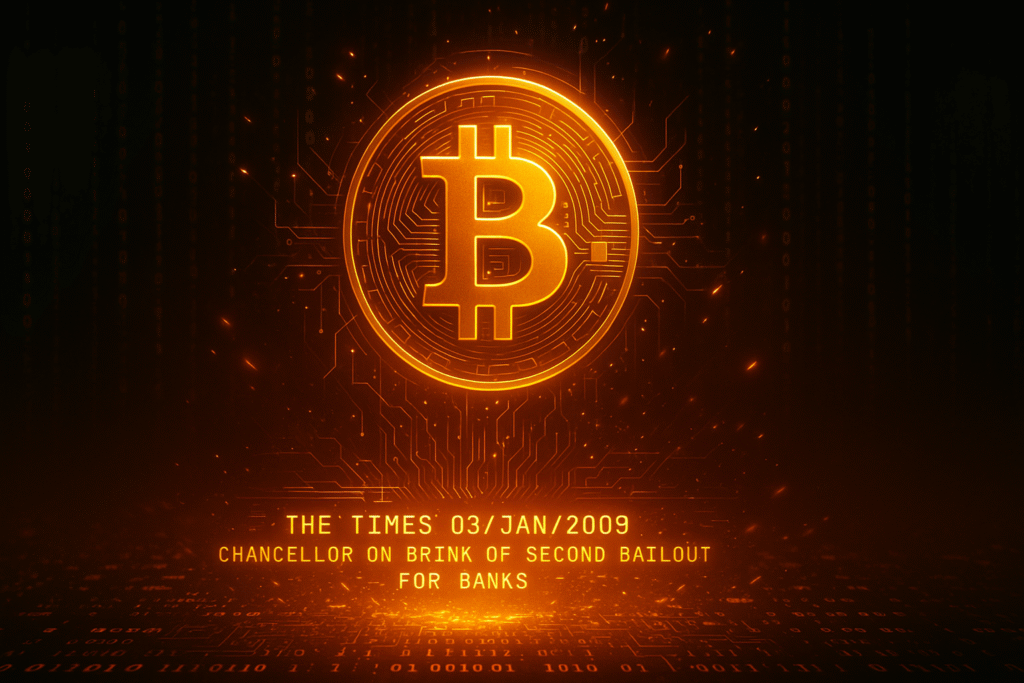
Bitcoin’s birth wasn’t a coincidence; it was a response. The 2008 financial crisis had exposed how fragile the global financial system really was. People watched banks get bailed out while citizens bore the cost. Satoshi’s proposal was radical in its simplicity: what if money could move directly between people – no middlemen, no banks, no gatekeepers? What if trust was replaced by mathematics? And so, in January 2009, the Bitcoin network went live with the mining of the genesis block, the very first block on its blockchain. Embedded in its code was a cryptic message: “The Times 03/Jan/2009 Chancellor on brink of second bailout for banks.” It wasn’t just a timestamp – it was a message of intent.
In those early days, Bitcoin was more philosophy than finance. There was no price chart, no hype, and no frenzy. The first recorded transaction between individuals was just 10 BTC exchanged for pizza. YES, actual pizza. It was a quiet experiment running on home computers, discussed mostly on cryptography forums by a handful of curious minds. Yet, beneath that simplicity was a technological breakthrough: the blockchain – a public ledger that made every transaction transparent, secure, and immutable without needing a central authority.
As word spread, Bitcoin began to attract miners, developers, and dreamers. It represented freedom for some, innovation for others, and confusion for almost everyone else. Traditional economists dismissed it as digital nonsense, while early adopters treated it like digital gold. Slowly but surely, it gained traction. Exchanges emerged, prices began to form, and people started realizing that this “internet money” wasn’t going away. The combination of scarcity (only 21 million coins), transparency, and decentralization gave Bitcoin a kind of credibility that no government currency could match.
Today, Bitcoin stands as more than just a financial instrument – it’s a symbol of what happens when technology meets ideology. Its origin story is equal parts mystery, genius, and defiance. Nobody knows who Satoshi Nakamoto really was – one person, a group, or something else entirely. But maybe that’s the point. Bitcoin wasn’t built to have a face or a CEO; it was built to give power back to the people. And whether one sees it as digital gold or a grand social experiment, its beginning remains one of the most important, and fascinating, stories in modern history.