
Key Takeaways
- The latest Cardano price bounce was driven by weak technical signals, not strong buyer demand.
- On-chain data shows rising profit-taking every time ADA attempts a rally.
- Whale wallets and derivatives traders are positioned for downside, not a breakout.
Cardano has done this before. The price lifts just enough to spark hope, traders start watching resistance levels, and then momentum quietly fades. Over the past week, ADA climbed around 7% before stalling again near $0.35. For anyone tracking the Cardano price bounce, the pattern feels painfully familiar.
This is not a story about panic or collapse. It is about why ADA rallies keep losing strength before they can turn into something meaningful. The data shows that each bounce is running into the same invisible wall. And once you see what is happening beneath the surface, the repeated failures start to make sense.
A Weak Technical Signal Sparked the Latest Cardano Price Bounce
The recent Cardano price bounce began with a hidden bullish divergence on the 12-hour chart. The price formed a slightly higher low while the Relative Strength Index (RSI) printed a shallow lower low. On paper, this can look encouraging.
In practice, it matters how strong the signal is. A shallow RSI divergence usually means sellers are stepping back, not that buyers are stepping in aggressively. That distinction is critical. It explains why ADA only managed a brief push toward $0.37 on January 21 before losing momentum again.
Development Activity Helped Temporarily but Failed to Sustain the Move
Around the same time ADA approached $0.37, Cardano development activity peaked near 6.94. That was the highest reading in roughly a month. Development metrics often act as a confidence boost, especially for long-term holders.
The issue is that the support did not last. Development activity slipped shortly after peaking, and the price followed. Even now, activity sits near 6.85, still below the recent high. The Cardano price bounce was cushioned, not powered, by development progress.
Profit Booking Accelerates Every Time ADA Rises
This is where the structure turns decisively bearish. On-chain data from spent coins age bands shows that holders are selling into every rally faster than before. In late December, ADA gained around 12% while spent coin activity jumped more than 80%. In mid-January, a 10% price rise triggered nearly a 100% spike in coin movement.
Since January 24, spent coin activity has already increased from about 105 million to 117 million, even though the price has not broken resistance. The message is simple. Each Cardano price bounce is being treated as an exit opportunity, not the start of a new trend.
Whale Wallets Are Reducing Exposure Instead of Absorbing Supply
When profit-taking rises, whales often step in to absorb selling pressure. That is not happening here. Wallets holding between 10 million and 100 million ADA have reduced balances by roughly 20 million ADA since January 21. Wallets in the 1 million to 10 million ADA range have shed close to 10 million ADA since January 22.
These are controlled reductions, but they matter. Without whale accumulation, the Cardano price bounce becomes fragile. Selling pressure has fewer buffers, making downside moves sharper when momentum fades.
Derivatives Data Shows Traders Expect Rallies to Fail
Derivatives markets are reinforcing the same narrative. Over the next seven days, short liquidations total roughly $107.6 million, while long liquidations sit near $70.1 million. Shorts outweigh longs by more than 50%.
This imbalance suggests traders are positioning for rejection, not continuation. When a Cardano price bounce approaches resistance, the market is already leaning toward another pullback.
Cardano Price Levels That Define the Next Move
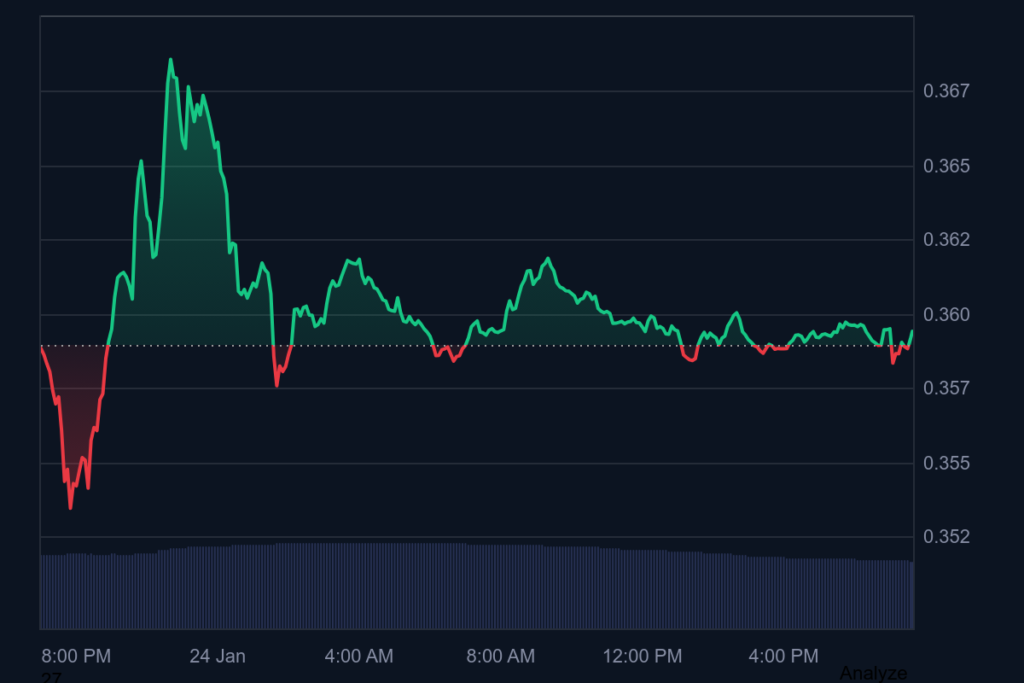
Price structure brings everything together. On the upside, $0.37 remains the first barrier. A clean break above it could trigger short liquidations, but the real momentum shift would only come above $0.39. Beyond that, $0.42 is where the broader structure turns bullish again.
On the downside, $0.34 is the key support. A loss of this level could trigger long liquidations and accelerate selling as leverage unwinds. Until one of these levels breaks decisively, the Cardano price bounce remains trapped in a familiar range.
What Needs to Change for Cardano to Break the Cycle
For this pattern to end, three things must align. Development activity must reclaim and hold above recent highs. Spent coins activity must slow instead of rising during rallies. And whales need to return as net buyers.
Until then, each Cardano price bounce is likely to remain a short-lived relief rally rather than the start of a sustained move. The data is not bearish because of fear. It is bearish because behavior has not changed.
Frequently Asked Questions
Why does the Cardano price bounce keep failing near $0.37?
Because profit-taking increases sharply near that level, while whale demand and derivatives positioning fail to support further upside.
Is Cardano development activity still strong?
Yes, development activity remains healthy, but it has not broken above recent highs strongly enough to drive sustained price demand.
Are whales selling Cardano right now?
Whales are not panic-selling, but they are reducing exposure slightly, which removes an important layer of price support.
What price level would signal a real trend change for ADA?
A sustained move above $0.39 would indicate improving momentum, while $0.42 would suggest a broader bullish structure.
Is the current Cardano price bounce bullish or bearish?
The bounce is technically neutral but structurally weak, with on-chain and derivatives data leaning bearish.