Highlights
- 32% of financial advisors now allocate crypto to client portfolios, with most allocating over 2%.
- Institutional access has doubled since 2023, unlocking steady advisor-driven capital flows.
- Bitcoin remains the core allocation, while stablecoins and tokenization signal maturing use cases.
Crypto markets are often shaped by loud participants. Retail traders chase momentum. Headlines focus on ETF inflows. Price spikes dominate attention. Yet, some of the most powerful shifts happen quietly, far from social media timelines.
That quiet shift is now coming from financial advisors. New data shows advisors are allocating to crypto at record levels, not as speculation, but as part of long-term portfolio strategy. This is slow money, patient money, and historically, it tends to matter far more than hype-driven flows.
Advisors Are Allocating Crypto at Record Levels
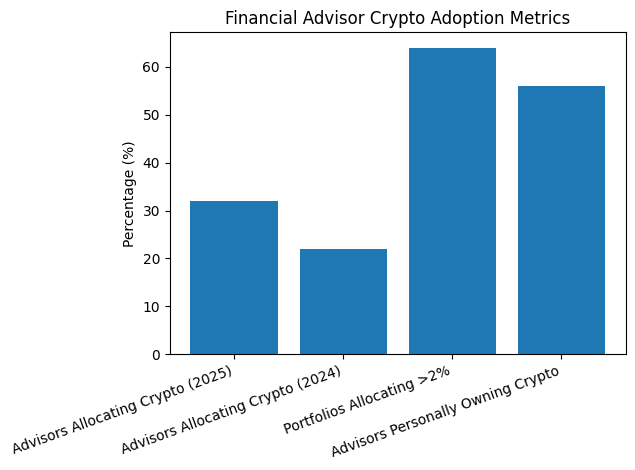
Recent survey data from Bitwise highlights a meaningful turning point. 32% of financial advisors reported allocating crypto to client portfolios over the past year, up from 22% in 2024. That is the highest reading since the survey began in 2018.
More important than adoption is allocation size. Among portfolios that include crypto, 64% now allocate more than 2% of total assets. This suggests crypto is no longer treated as a symbolic position. Advisors are building intentional exposure that is large enough to matter.
Personal ownership supports this trend. 56% of advisors now personally own crypto, the highest level ever recorded. Advisors tend to recommend assets they understand and believe in. This alignment between personal conviction and professional allocation is a strong signal that crypto has crossed an internal trust threshold.
Access, Not Hype, Is Driving This Shift
For years, many advisors did not avoid crypto because they disliked it. They avoided it because it was operationally difficult. Custody, compliance, reporting, and regulatory uncertainty created friction.
That friction is fading. 42% of advisors now report having institutional access to crypto products for clients, up from just 19% in 2023. As crypto became available through regulated custodians and ETFs, allocation followed naturally.
This explains why adoption is accelerating without noise. When crypto fits into existing wealth management systems, advisors do not need to reinvent their process. They can buy, rebalance, and report crypto the same way they handle equities or bonds. Once access exists, behavior changes quietly but consistently.
Bitcoin Remains the Anchor Asset
While advisors are exploring new crypto themes, Bitcoin remains the foundation of most allocations. The reason is simple. Bitcoin offers clarity.
It has deep liquidity, expanding regulatory acceptance, and a narrative advisors already understand. Scarcity. Monetary debasement. Portfolio diversification. These are familiar concepts in traditional finance.
Bitcoin recently reached a 2-month high near $95,000, supported by strong ETF demand. Bitcoin ETFs saw more than $750M in net inflows in a single day, the largest since October. For advisors, this reinforces confidence. Liquidity attracts liquidity, and Bitcoin continues to dominate institutional attention.
In portfolio discussions, Bitcoin is not positioned as a short-term trade. It is framed as a long-term hedge and asymmetric exposure, which aligns well with advisor-client conversations.
Stablecoins and Tokenization Are Gaining Advisor Interest
Beyond Bitcoin, advisor interest is shifting toward practical use cases. Stablecoins and tokenization ranked as the most exciting themes, with 30% of advisors selecting them as top areas of focus.
This matters because it signals maturity. Advisors are moving beyond price appreciation narratives and toward infrastructure that improves how money moves. Stablecoins enable faster settlement and global payments. Tokenization promises efficiency gains for traditional assets like bonds and private credit.
Real-world adoption reinforces this shift. Payment networks like Visa are integrating stablecoin settlement into existing rails. When familiar institutions adopt crypto infrastructure, advisors gain confidence that these tools are here to stay.
Regulation Is Unlocking Capital, With Caveats
Regulatory clarity remains one of the most important variables. Draft provisions in proposed legislation could grant assets like XRP and Solana the same non-security status as Bitcoin and Ethereum. If enacted, this would significantly reduce legal uncertainty and expand advisor participation.
At the same time, concerns remain. Galaxy Research has warned that some proposals may increase Treasury surveillance authority. Advisors are watching carefully. Clear rules enable allocation, but excessive oversight could introduce new risks.
The key point is this. Regulation is no longer a binary obstacle. It is an evolving framework that is gradually making crypto investable within traditional portfolios.
The Slow Money Effect
Financial advisors do not move quickly. They analyze, document, and implement changes cautiously. But once they commit, they rarely reverse direction without strong reason.
This is why their participation matters so much. Advisor-led flows are not explosive. They are consistent. Regular contributions, periodic rebalancing, and long-term positioning create steady demand over years, not weeks.
Some describe this as an “infinite TWAP.” In simpler terms, it is continuous buying pressure that does not depend on headlines or hype. Historically, this type of flow reshapes markets far more sustainably than speculative surges.
A Different Kind of Crypto Cycle
Crypto’s next growth phase may not look dramatic. It may not trend on social media. But it is being built through infrastructure, regulation, and professional adoption.
Financial advisors are treating crypto as a portfolio asset, not a gamble. Bitcoin anchors exposure. Stablecoins and tokenization expand utility. Access continues to improve. The result is a slow but powerful reallocation of capital.
This is not fast money chasing returns. It is patient money positioning for the long term. And that may be the most bullish signal crypto has seen yet.
Frequently Asked Questions
Why are financial advisors investing more in crypto now?
Improved access through ETFs, clearer regulation, and growing client interest have made crypto easier to integrate into traditional portfolios.
How much crypto do advisors usually allocate?
Among portfolios with crypto exposure, most allocate more than 2%, often starting around 1% and increasing over time.
Is Bitcoin still the main crypto asset for advisors?
Yes. Bitcoin remains the primary allocation due to its liquidity, ETF availability, and macro hedge narrative.
Are stablecoins considered an investment?
Advisors view stablecoins more as financial infrastructure than speculative assets, focusing on payments and settlement efficiency.
Does regulation make crypto safer for investors?
Regulatory clarity reduces legal uncertainty, but investors should remain aware of privacy and policy risks as frameworks evolve.